
New Coaches
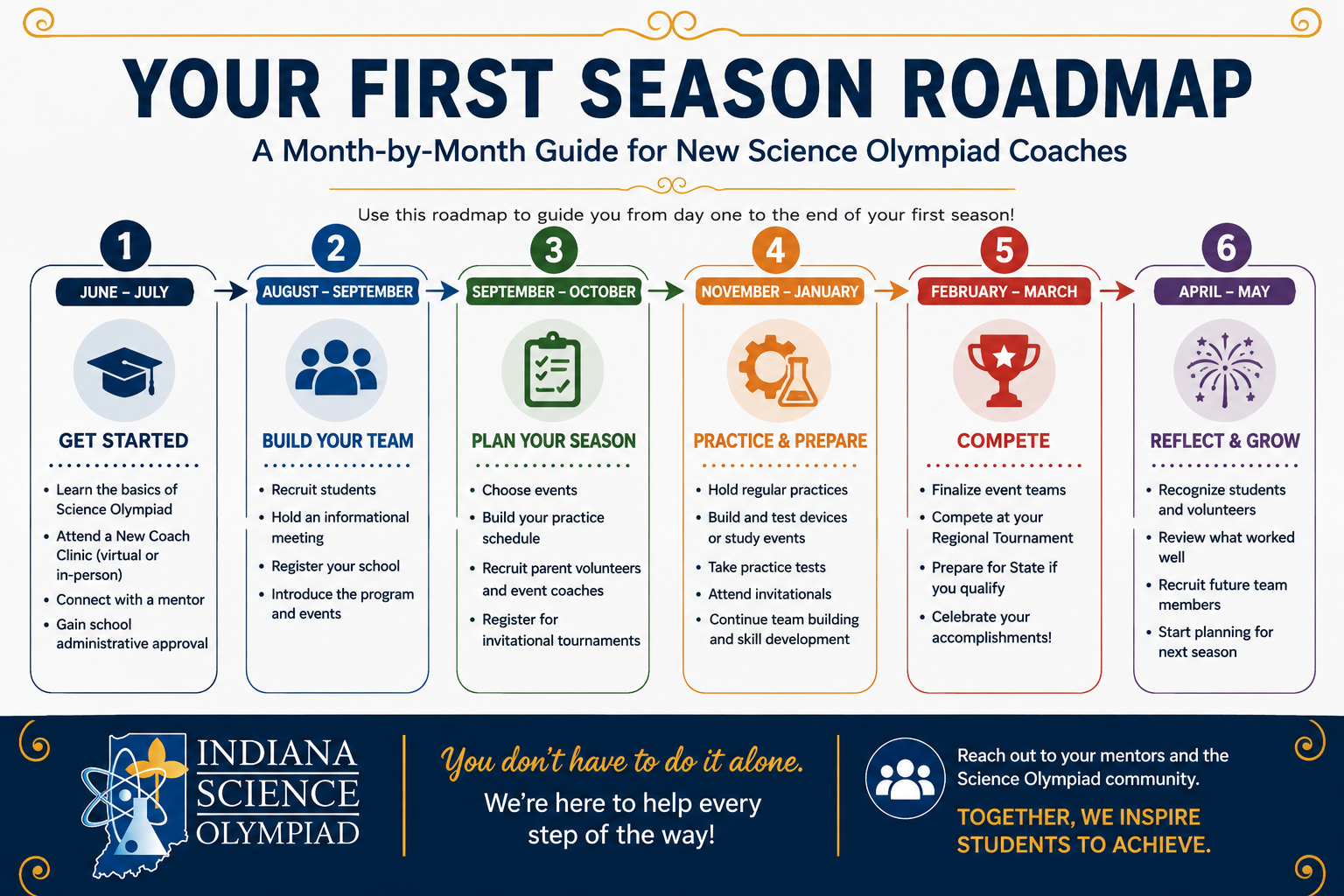
Welcome to Indiana Science Olympiad! Whether you’re starting a new team or coaching for the first time, this guide will walk you through the season from registration to your first competition.
New Coaches
Everything you need to start and grow a successful Science Olympiad team.
Tournament Calendar
View all upcoming tournaments.
Register
Register for Indiana Science Olympiad tournaments.
Results
Browse tournament results and past champions.
Resources
Tournament guides, policies, schedules, FAQs, and forms.
Welcome to Indiana Science Olympiad!
Science Olympiad is about much more than competition—it’s an opportunity for students to develop teamwork, problem-solving skills, and a passion for STEM. Whether you’re coaching one team or several, Indiana Science Olympiad is here to support you throughout the season.
Register Your Team
Complete your National and Indiana registration.
Recruit Students
A successful Science Olympiad team includes students with a wide range of interests and talents. A full team consists of 15 students, but many schools begin with fewer and grow over time. Don’t wait until you have a full roster—start with the students you have and build from there.
Where to Find Students
- Open Houses & Back-to-School Nights – Set up a table with photos, medals, event examples, and hands-on activities to introduce families to Science Olympiad.
- Morning Announcements & School Newsletters – Invite students to an informational meeting or interest session.
- Teacher Recommendations – Ask math, science, technology, engineering, agriculture, and STEM teachers to recommend students who enjoy solving problems, building, designing, or learning new things.
- Current Team Members – Encourage returning students to invite friends who may enjoy being part of the team.
Look Beyond Grades
Science Olympiad isn’t just for students with straight A’s or those who already love science. Many successful competitors are creative builders, artists, coders, problem-solvers, writers, or students who simply enjoy learning and working as part of a team.
Some students may not think they’re “smart enough” for Science Olympiad. Those are often the students who benefit the most. Encourage teachers to recommend students who are curious, hardworking, creative, and willing to try something new—even if they don’t see themselves as a “science kid.”
Tip: A diverse team with different strengths and interests is often more successful than a team made up of only top academic performers.
Choose Events
Help students discover events that match their interests, strengths, and learning styles. Science Olympiad includes 23 events covering biology, chemistry, physics, engineering, earth science, technology, and inquiry.
A full team competes across all events, but you are not required to enter every event. While leaving events unfilled will affect your team’s overall score, many new or smaller teams begin by focusing on the events they can support and expand their participation each season.
Most events are completed by teams of two students, while a few events allow teams of three. Encourage students to work together, balance their strengths, and choose events they are excited to learn.
Coach Tip: Don’t assign events based solely on grades. Students who enjoy building, problem-solving, public speaking, coding, drawing, or hands-on projects often excel in Science Olympiad. A team with a variety of talents is stronger than one made up of only top science students.
Start Practicing
Develop a practice schedule that works for you, your students, and your school. Every successful Science Olympiad program looks a little different, and there’s no single “right” way to organize practices.
Some schools meet during the school day, while many hold practices before or after school. Some teams meet once a week, while others practice two or three times each week, especially as competitions approach.
Coaches also organize practices in different ways. Some divide students into event categories (Life Science, Earth & Space Science, Physical Science & Chemistry, Technology & Engineering, and Inquiry & Nature of Science) and recruit parent volunteers, teachers, or community members to help coach those groups. Others organize practices by event type, such as study events, build events, lab events, or inquiry events. Many coaches use a combination of both approaches.
As you gain experience, you’ll discover what works best for your team. Start with a schedule you can realistically maintain, communicate expectations clearly, and be willing to adjust as your students’ needs change throughout the season.
Coach Tip: Consistency is more important than frequency. A well-planned one-hour practice each week is often more effective than several unstructured meetings. Build a routine that fits your schedule, keeps students engaged, and allows your team to grow each season.